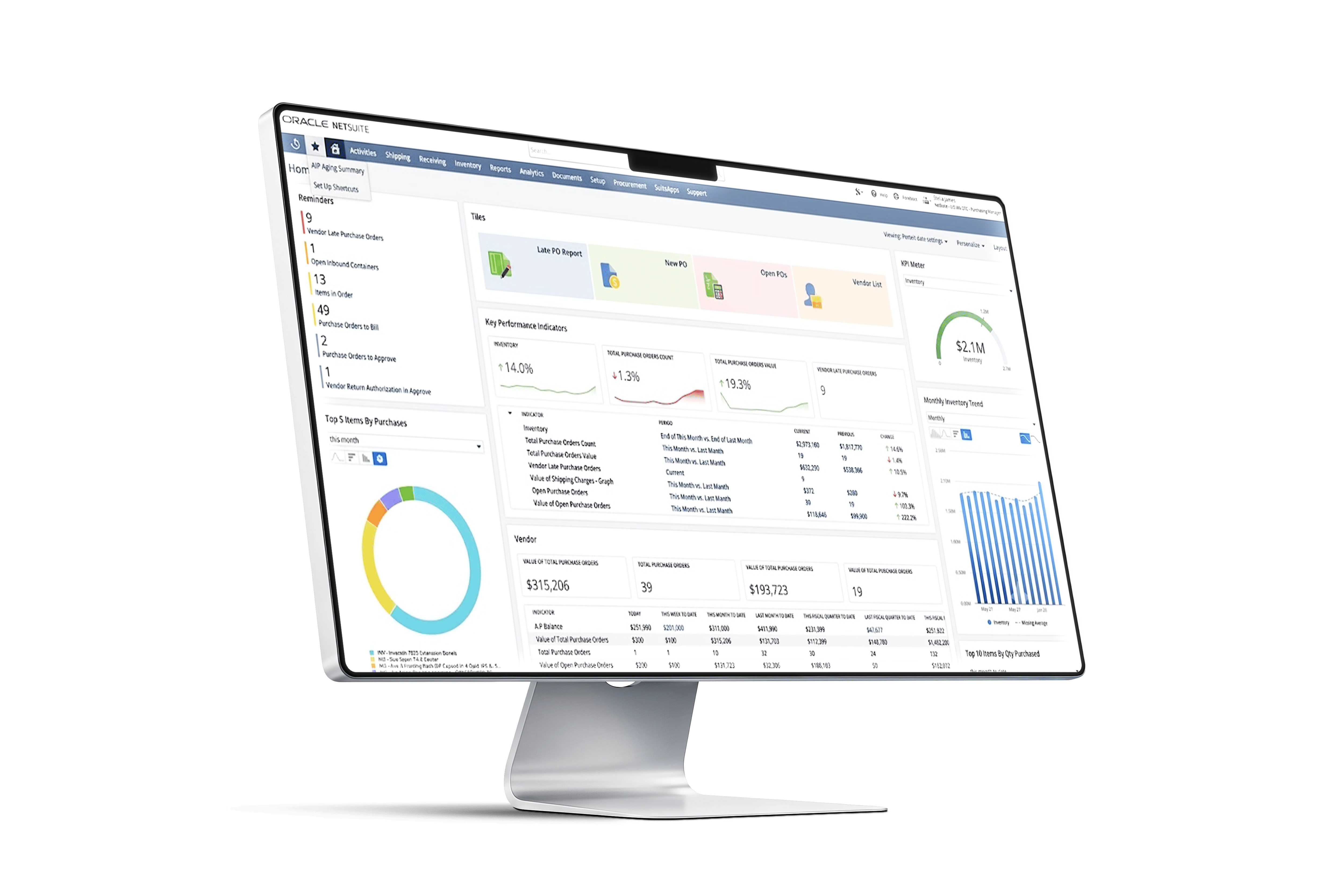
Stockouts cost sales and overstock ties up cash, and both happen when inventory runs on spreadsheets and periodic counts. NetSuite Advanced Inventory Management is the part of NetSuite that runs inventory on live data: demand planning, real-time tracking, optimization, and automated replenishment across every location, tied to your financials. Zanovoy implements and configures it to how your operation actually moves product.
Talk to an Inventory Advisor
















What It Does

Predicts future demand from historical sales while accounting for promotions, holidays, and external conditions, so safety stock targets reflect actual demand variability and lead times. The forecast adjusts faster during peaks and avoids slow-moving buildup that ties up working capital during lulls.

Captures transactions as they happen through barcode scanning and tagging, flowing into centralized dashboards, so you have an up-to-date view of inventory across every location. Batch and serial tracking link items to production lots or warranty records, which simplifies isolating products in a recall.

Calculates safety stock for each item and location based on demand variability and lead times, rather than one rule for everything, so high-volume and high-risk items get the coverage they need. Recommendations update as supplier performance and demand change, adjusting reorder points automatically.

Uses reorder points, min-max bands, and service targets to decide when and how much to order, generating purchase orders or transfer requests when stock falls below a threshold. It factors in lead times and order multiples so deliveries arrive on time and in the right pack sizes, with exception alerts for items that deviate from the plan.

Aggregates inventory across plants, distribution centers, and stores so every team sees the same locations and movements, with transfers based on actual available-to-move quantities. When demand spikes in one region, the system can redirect stock from a nearby facility with surplus rather than trigger an unnecessary purchase.

Lets teams receive, pick, move, and count from the warehouse floor, capturing data at the source to speed transactions and cut errors. Offline modes keep work moving in low-connectivity zones, syncing when the network returns, and managers can review KPIs and exceptions from anywhere.
See how this would run across your actual locations and SKUs.
Map This to Your WarehouseWhat You Get From It
01
Automated capture replaces the manual keying that introduces mistakes, so system-recorded and validated transactions produce cleaner ledgers and faster issue resolution.
02
Live visibility across every location keeps inventory aligned with demand, while rule-based reordering and smart allocation prevent stockouts without tying up cash in surplus.
03
Reducing excess stock and wasted storage space lowers carrying costs, and automating repetitive tasks puts your team's time where it's actually needed.
04
Demand-planning models that account for seasonality and market conditions produce more reliable predictions, which managers use to make sharper purchasing and production decisions.
05
Accurate, current information supports timely calls on sourcing and transfers, and dashboards surface the metrics and actions that actually move performance.
06
Directed picking and put-away, automated reordering, and barcode scanning cut manual touchpoints, and integration with your core platforms removes the need to enter data into multiple systems.
07
Products arrive when promised, which builds trust and repeat demand, and consistent availability protects revenue through promotions and seasonal peaks.
08
Greater visibility, analytics, and alerts surface problems like supplier delays and demand spikes early, so managers can act before a disruption escalates.
Turn stockouts and overstock into numbers you control.
Get Your Inventory ScopedWhy Work With Zanovoy on Inventory
Inventory accuracy comes from a configuration that matches reality, your locations, your reorder logic, your fulfillment flow, and your costing method. That is where an inventory implementation succeeds or leaves you with numbers you cannot trust. We lead with that work from the finance seat, so inventory and the financials stay in agreement, and the warehouse and the books tell the same story.
01
We configure inventory locations, reorder points, costing, and fulfillment workflows to match how you actually move product and connect inventory to the rest of your finance stack so stock and cost run as one system.
02
We support the inventory setup after go-live, so issues in stock accuracy or fulfillment are caught before they reach a customer or your month-end.
03
We handle the path to Advanced Inventory Management, so adding inventory depth does not become its own drawn-out project.
04
We configure inventory to your actual operation rather than forcing your warehouse and supply chain to fit a generic template.
05
The people who advise on the inventory setup are the people who implement it, integrate it, and support it afterward.
06
We tune your inventory, demand planning, and fulfillment configuration as you add SKUs, locations, and volume, so it keeps pace as the operation grows.
Accurate inventory comes down to configuration that matches reality.
Get Your Setup ScopedProfessionals on the Financial Transformation Team
Companies supported through IPO
Implementations delivered across 5 continents
Customizations built for enterprise clients
Integrations built across the platform ecosystem
Continents served
© Copyright 2025, All Rights Reserved by Zanovoy





.png)