B2B finance teams with usage-based, subscription, or hybrid billing know the pain: every contract bills differently, collections eat the month, and revenue recognition under ASC 606 is a manual risk. Tabs runs that entire contract-to-cash workflow on an AI-native platform. As a license reseller, Zanovoy implements Tabs and connects it to your ERP, so your billing, collections, and RevRec run as one system.
Talk to a Tabs Implementation Advisor
















What Finance And Revenue Leaders Tell Us
Most finance teams running complex B2B billing started with an invoicing tool and a spreadsheet, and now spend the month holding the gap together by hand.
01
Usage-based, subscription, and hybrid contracts each carry their own logic. When the billing tool can't model them natively, finance builds the calculations by hand, and every custom contract becomes a recurring manual job and a source of error.
02
Chasing payments manually means DSO climbs and cash arrives late. Without a system driving collections, the finance team spends its month on follow-up instead of on the work that matters.
03
ASC 606 on recurring and usage-based revenue does not map cleanly to an invoicing tool. Manual schedules create restatement risk exactly when investors and auditors look closest.
Recognize your billing in these? We'll show you how Tabs closes the gap.
Fix the Contract-to-Cash GapWhat We Deploy

The contract ingestion engine reads your signed contracts directly from CRM, document storage, or email and extracts the commercial terms automatically. Pricing, billing schedules, escalators, custom clauses, usage metrics, and renewal terms get structured into bill-ready logic without manual transcription. The contract becomes the source of truth for billing, rather than the spreadsheet someone built downstream of the contract.
The billing engine generates invoices automatically from the structured contract data, supporting subscription, usage-based, metered, hybrid, and custom billing models natively. Invoices go out the moment they should, based on contract terms, not on a finance team member's manual run, and reflect the actual contract structure rather than a simplified approximation of it. Amendments, midterm changes, and commercial updates get absorbed in real time so every invoice stays accurate.
The collections engine monitors invoice status, automates payment reminders, and applies incoming payments against the right invoices without manual matching. Days sales outstanding drops because the chase work that used to live in a finance team member's inbox now runs as an automated workflow with exception handling. Cash application happens in real time rather than as a weekly reconciliation exercise.
The revenue recognition engine automates ASC 606-compliant revenue recognition against your actual contract terms. Performance obligations get identified from contract structure, revenue gets recognized against the right schedule, and the revenue waterfall stays current without anyone manually maintaining the underlying logic. Audit-ready records, real-time revenue visibility, and compliance that does not depend on the institutional knowledge of one finance team member.
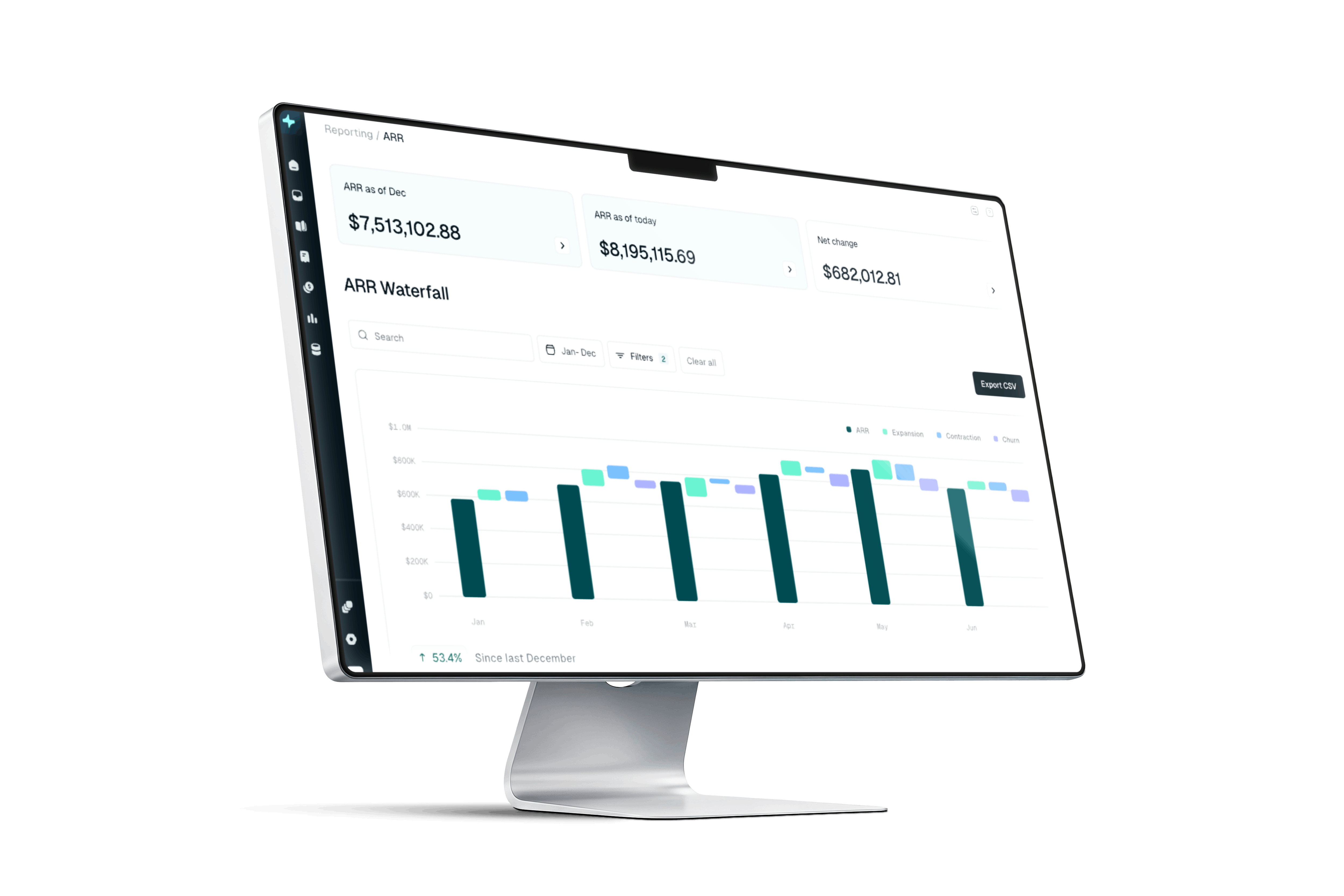
The reporting layer surfaces real-time revenue analytics, ARR, MRR, recognized revenue, billings, collections, DSO, and customer-level revenue trends without anyone exporting data to a spreadsheet first. Finance, RevOps, and leadership read the same numbers the same way, with the underlying data tied to the contracts and transactions that drive them rather than to a reconciliation process that runs once a month.
The platform runs on a foundation of AI agents purpose-built for finance and accounting work. The agents handle the routine work, invoice generation, payment reminders, cash application, and reconciliation autonomously, flagging exceptions only when human judgment is required. Slack-native workflows let your finance team review and approve from where they already work. The result is a finance function whose senior team members spend their time on strategy rather than on manual data entry.
Billing and collections only, or the full contract-to-cash workflow? We'll scope where your pain is sharpest.
Scope Your Tabs FootprintWhy Work With Zanovoy on Tabs
A billing platform only delivers when it connects cleanly to the system of record behind it. We lead with the integration and configuration work that makes Tabs actually shorten your close, and we come at it from the finance seat, not a generalist IT one.
As a license reseller, we configure Tabs to your contracts and billing models and connect it to your ERP, whether that is NetSuite, Rillet, or Campfire, so billing, RevRec, and the general ledger run as one system.
We support Tabs after go-live, so issues in your billing and collections workflow are handled before they reach your month-end.
We handle the path onto Tabs so your finance team moves to it without the implementation becoming its own project.
Tabs is built to go live in weeks, not quarters, and we keep it that way, configuring it to how you sell rather than forcing your contracts to fit the tool.
The people who advise on Tabs are the people who implement it, integrate it, and support it afterward.
We tune Tabs and its integrations as your billing models and contract volume grow, so the platform keeps pace with how your business sells.
Tabs only shortens your close when it connects cleanly to the ledger behind it. That's the work we lead with.
Get Your Tabs Integration ScopedProfessionals on the Financial Transformation Team
Companies supported through IPO
Implementations delivered across 5 continents
Customizations built for enterprise clients
Integrations built across the platform ecosystem
Continents served
Our Process
A revenue workflow that runs without manual intervention is the outcome. The four phases below are the work that delivers it.
01
Current-state review of how your team manages contracts, billing, collections, and revenue recognition today. We map your billing models, your CRM and ERP footprint, your existing reconciliation processes, and the operational bottlenecks before recommending which Tabs capabilities to deploy first.
02
Tabs capability scope (contracts, billing, collections, revenue recognition, reporting, and agents, whose combination applies to your situation); integration architecture connecting Tabs to your CRM and ERP; contract ingestion logic design; revenue recognition rule configuration; and the change management structure the rollout will require.
03
Contract migration, integration build, billing model configuration, revenue recognition rule setup, user training scoped to finance and RevOps, parallel-run validation, and cutover. The senior consultants who scoped the engagement stay accountable through delivery, even when day-to-day build moves to the implementation team. Handoffs happen; the accountability does not.
04
Managed services, integration maintenance, contract ingestion refinement, new billing model rollout as the business evolves, and the ongoing optimization that keeps Tabs aligned with how your sales motion and revenue model actually run.
Step 01 is a qualification, not a sales call. We compare Rillet against NetSuite and Campfire, stress-test the assumptions, and tell you the honest read. Zero bias.
Start With Qualification TodayTestimonials







© Copyright 2025, All Rights Reserved by Zanovoy





.png)